
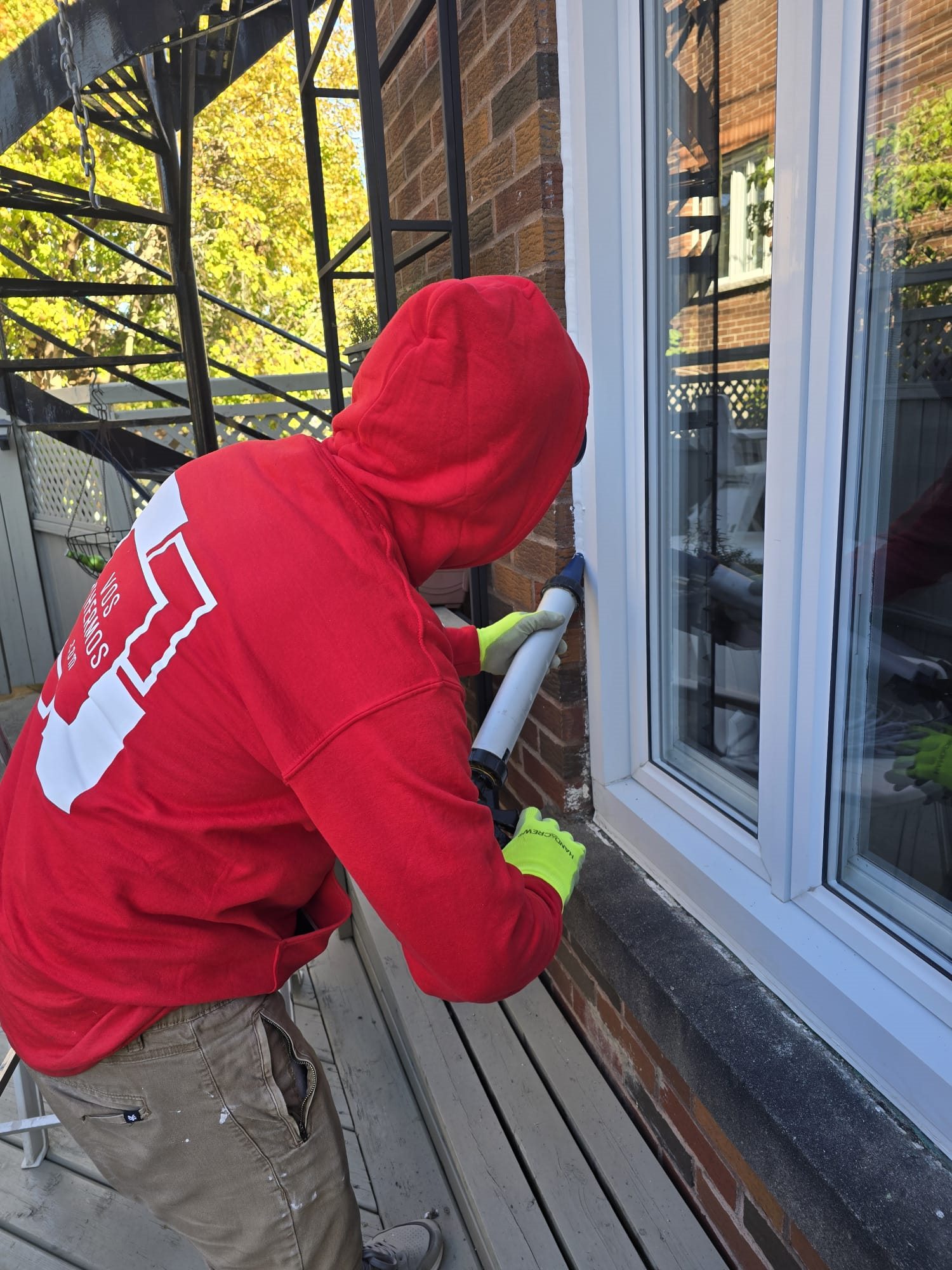
Caulking: your home's first line of defence
Caulking is that bead of flexible sealant applied around the outside of your windows and doors, where the frame meets the wall. Its job is to seal that junction so water, cold air and insects can't work their way into your home's structure. It's a maintenance item that often gets overlooked, but its impact on your home's comfort and energy efficiency is considerable.
In Quebec, caulking takes a beating. Temperature swings of more than 60 degrees Celsius between summer and winter make materials move: wood, aluminum, vinyl and masonry expand and contract at different rates. After a few years, even the best caulking eventually cracks, pulls away or hardens to the point where it no longer seals.
Signs it's time to redo your caulking
Inspect the exterior caulking on all your windows and doors at least once a year, ideally at the end of summer. Here's what to watch for:
Cracks and crazing
The most obvious sign. Cracks in the caulking, even small ones, let water and air seep in. Water that gets in behind the window frame can cause major damage to the wall structure, rotting wood, corroding steel, degrading insulation, and eventually leading to mould hidden inside the walls.
Separation
The caulking no longer makes contact with the window frame or the wall cladding. You can see a gap between the sealant and the surface. This often happens when a low-quality caulking was used or when the surface wasn't properly prepared before application.
Hardening
Caulking that has lost all flexibility and become as hard as plastic can no longer follow the movement of expansion and contraction. It will inevitably crack or pull away. Press the caulking with your fingernail: if it doesn't spring back, it's time to replace it.
Mould or discolouration
Caulking with surface mould or significant colour change can mean moisture is building up behind it. That's a sign you need to act quickly.
Types of caulking: choosing the right product
Product choice is crucial to how long the job lasts. Not all caulkings are equal:
Pure silicone
The most durable and the most flexible. It handles extreme temperatures (-40 to +200 degrees Celsius) and UV rays, and doesn't harden over time. Lifespan: 20 to 50 years. Drawback: it can't be painted and gives off an acetic acid smell while curing. Ideal for spots where the natural colour (white or clear) is acceptable.
Polyurethane
Excellent product, durable and paintable. Good adhesion on most surfaces. Lifespan: 15 to 25 years. It's the recommended choice for most exterior window and door caulking applications when you want to paint over it.
Acrylic latex (with silicone)
The most common and most affordable product. Easy to apply, paintable, cleans up with water. However, its lifespan is much shorter: 5 to 10 years. It tends to harden and crack faster than silicone or polyurethane, especially in our climate. It's an acceptable choice for sheltered areas, but avoid it on south and west exposures where the sun is intense.
Expanding foam
It isn't caulking in the traditional sense, but it's used to fill wider gaps around window and door frames. Low-expansion foam is recommended for windows, since high-expansion foam can distort frames. It must always be protected from UV with caulking, paint or cladding.
How to apply caulking properly
Surface preparation is the key to caulking that lasts:
- Remove the old caulking completely. Never apply new over old. Use a putty knife, a scraper or a specialized removal tool. Stubborn residue can be softened with a caulk remover.
- Clean the surface. Remove dust, dirt, sealant residue and flaking paint. The surface must be clean and dry.
- Apply a primer if needed. Some caulkings adhere better with a primer, especially on porous surfaces like brick or concrete.
- Cut the nozzle at 45 degrees for an even bead. The hole diameter should match the width of the joint you're filling.
- Apply in one continuous motion with steady pressure. Avoid stops and restarts, which create weak points.
- Tool it right away with a wet finger or a smoothing tool for a clean finish and good contact with both surfaces.
The best time to caulk
The ideal temperature for applying caulking is between 10 and 25 degrees Celsius. Avoid days that are too hot (the product will cure too fast) or too cold (reduced adhesion). In Montreal and on the South Shore, the ideal window falls between mid-August and mid-October. Don't apply caulking in the rain or if rain is forecast within the next 24 hours.
Interior caulking: often forgotten
People mostly think about exterior caulking, but interior caulking matters just as much. The joint between the window frame and the interior wall (often hidden by the trim) acts as an air barrier. If that joint is faulty, warm, humid air from inside the house can get into the wall cavity, cause condensation inside the wall and lead to mould you can't see. When you're replacing trim or doing work around your windows, that's the ideal time to check and redo that interior joint.
Is your window caulking due? The Vosthermos team offers complete exterior and interior caulking service for windows and doors. Call us at 514-825-8411 for a free quote. We move quickly before winter throughout the Montreal area.