
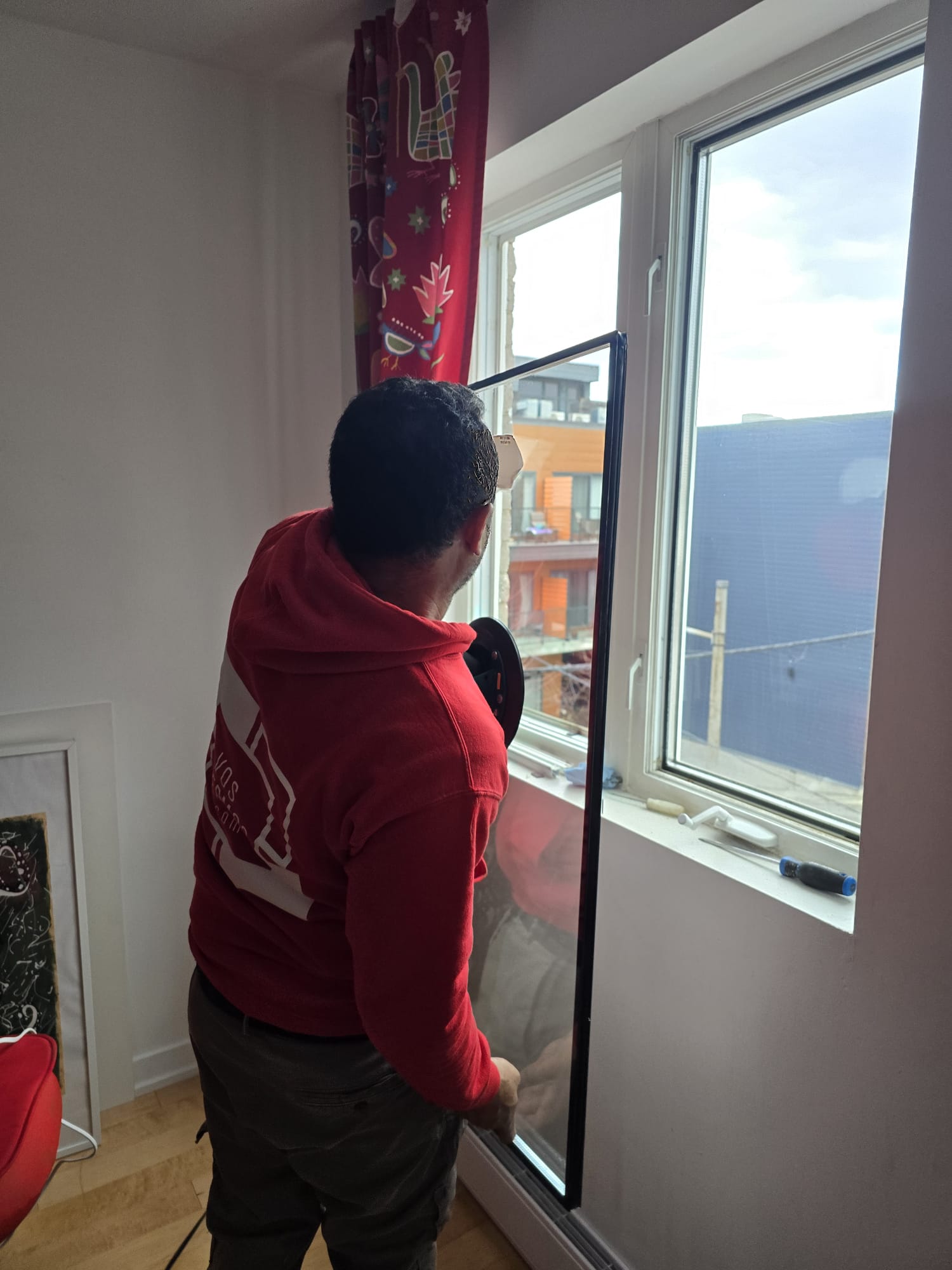
Technology in the service of comfort
When the time comes to replace a window thermos (sealed glass unit), you'll probably hear about Low-E glass and argon gas. These technologies have become the industry standard in fenestration, but many homeowners don't fully understand what they do or whether they're worth the extra cost. This article demystifies these technologies and helps you make an informed choice.
What is Low-E glass?
Low-E stands for "low emissivity." It's a microscopic metallic coating applied to one of the glass surfaces during manufacturing. This coating is invisible to the naked eye; you won't see it and you won't feel any difference to the touch.
The job of the Low-E coating is to control heat transfer by radiation through the glass. To understand it, you need to know that heat crosses a window in three ways: by conduction (through the material), by convection (through air movement) and by radiation (through infrared waves). Low-E glass acts specifically on radiation, which accounts for roughly 60% of heat transfer through a standard window.
How it works in winter
In winter, the heat in your home radiates outward through the windows. The Low-E coating acts like a mirror for infrared waves: it reflects indoor heat back inside the house instead of letting it pass through the glass. The result: heat stays inside, the interior surface of the pane is warmer, and your heating system works less.
How it works in summer
In summer, the process is reversed. The sun heats the outside and that heat tries to get inside through radiation. The Low-E coating reflects part of that solar heat back outside, reducing solar heat gain and keeping your home cooler. That reduces the load on your air conditioning.
The different types of Low-E
There are two broad categories of Low-E coating:
- "Hard coat" Low-E (pyrolytic): applied during glass manufacturing at high temperature. More durable but less efficient. Less common today.
- "Soft coat" Low-E (sputtered): applied in a vacuum chamber at the factory after the glass is made. Higher performing, it's the type most used in modern thermos units. It has to be protected inside the sealed unit because it's fragile when exposed to air.
There are also different Low-E "recipes" suited to different climates. In Quebec, we generally use a Low-E optimized for solar gain (high Solar Heat Gain Coefficient), because we want to maximize free heat from the sun in winter. In hot regions, a Low-E that blocks solar gain is used instead.
What is argon gas?
Argon gas is an inert, odourless and non-toxic gas that fills the space between the two panes of the thermos. It replaces the air that would normally fill that space. Argon is denser than air and conducts heat less efficiently, which slows heat transfer by conduction and convection through the sealed unit.
Argon lowers the thermos U-value (the U-value measures heat transfer; the lower, the better) by about 15 to 20% compared with an air-filled thermos. That's a significant gain for a modest extra cost.
What about krypton?
Krypton is another inert gas that performs even better than argon (about a 40% reduction in U-value). However, it's much more expensive. Krypton is generally reserved for triple-glazed thermos units where the space between panes is thinner, because krypton performs better than argon in narrow spaces. For a standard double-glazed thermos with a 12 to 16 mm space, argon offers the best performance-to-price ratio.
Combined performance: Low-E + argon
Pairing Low-E glass with argon gas is the standard combination in modern high-performance thermos units. Here's how the performance compares:
- Standard thermos (clear glass + air): R-value around 2.0
- Thermos with Low-E only: R-value around 2.8
- Thermos with argon only: R-value around 2.3
- Low-E + argon thermos: R-value around 3.3 to 3.7
- Triple glazing with Low-E + argon: R-value around 5.0 to 7.0
The Low-E + argon combination therefore delivers a 65 to 85% improvement in insulating value compared with a standard thermos. That's a huge difference, and it translates directly into comfort and energy savings.
ENERGY STAR certification
In Canada, the ENERGY STAR program certifies windows according to their energy performance. Since 2020, there are no more climate zones: a single criterion applies across the country, namely an Energy Rating (ER) of at least 34 or a U-factor of no more than 1.22 W/m²·K. In practice, that calls for a Low-E thermos with argon at minimum.
When you replace a thermos, even if you're not replacing the complete window, specifying a Low-E thermos with argon ensures your window's performance will be comparable to that of a new ENERGY STAR certified window.
The extra cost: is it worth it?
A Low-E + argon thermos costs a bit more than a standard clear-glass thermos: at Vosthermos, the option adds a few dozen dollars per unit. The exact amount appears in our thermos replacement price list.
In return, the glass insulates better: its interior surface stays warmer in winter, condensation drops and your heating works less. As a benchmark, Hydro-Québec indicates that ENERGY STAR certified windows are 20% to 40% more efficient than conventional models.
At Vosthermos, we offer both options (standard clear glass and Low-E + argon) for every thermos replacement. We systematically recommend the Low-E + argon option for north- and west-facing windows, where heat loss is greatest. For south-facing windows that enjoy good winter sunlight, a high-solar-gain Low-E is ideal.
Want to take advantage of Low-E glass and argon in your replacement thermos units? Contact Vosthermos at 514-825-8411. We'll advise you on the best option for each window in your home. Free quote in Montreal, the South Shore and Laval.